Google AI Mode Links Get More Prominent, but Clicks Remain the Test
Google began repositioning links inside AI Mode and AI Overviews on October 15, placing citations higher in generated responses and giving select official pages, news articles, related stories and creator profiles more visible placement. The change affects publishers who depend on Google referral traffic and SEO professionals who track how AI search surfaces and credits source content.
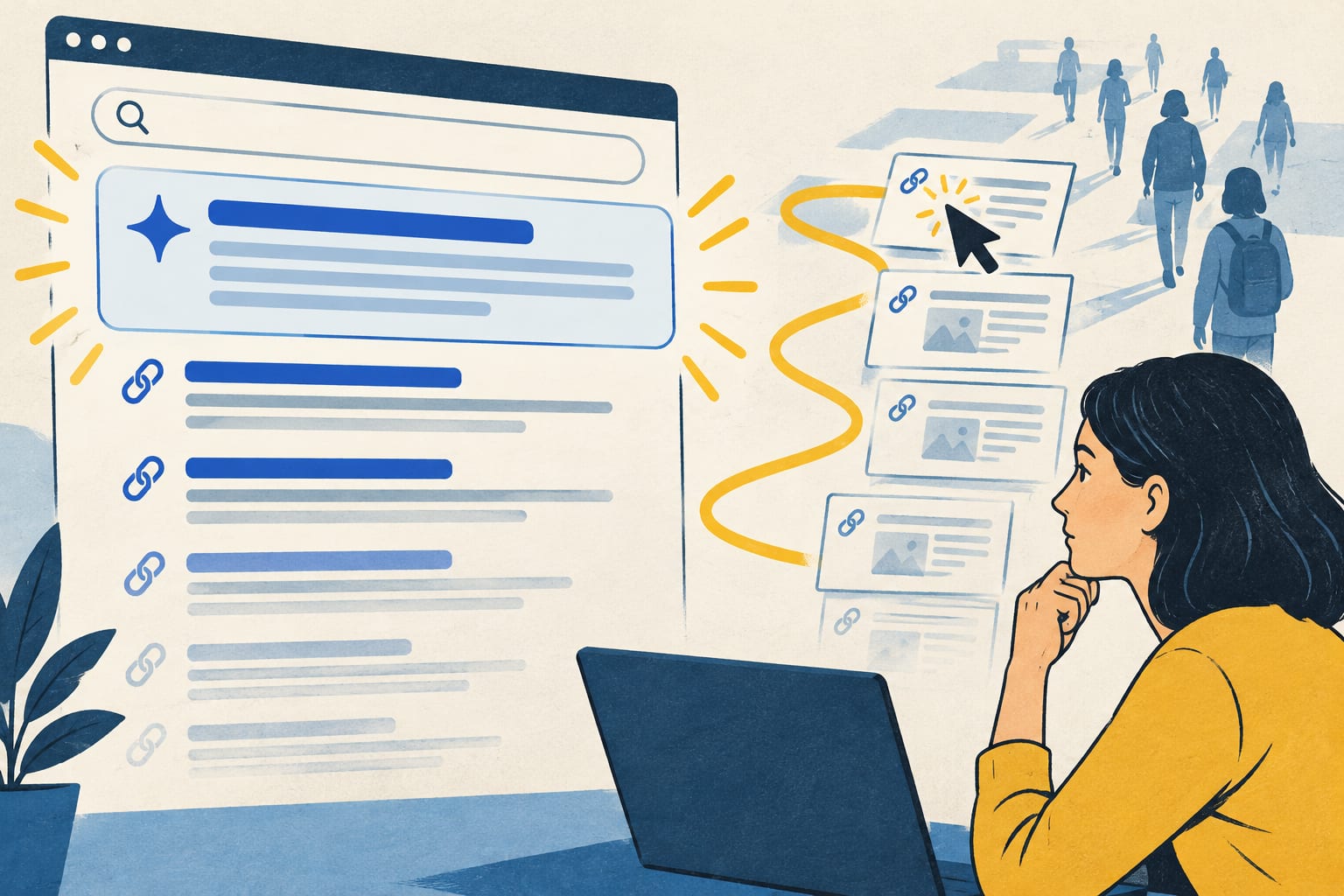
The update touches five parts of Google's AI search experience. Inline links, the citations attached to specific claims within a generated answer, are now appearing higher and more frequently, a shift meant to catch users before they stop scanning and accept the response as sufficient. Google is also testing a dedicated section for queries with one or two clear official destinations, such as an airline refund page, elevating that link above the generated explanation rather than burying it underneath. Article carousels for timely topics are expanding to more locations and languages, and Google says use of its Preferred Sources personalization feature has grown more than sevenfold since the start of 2026. Related-article links are getting image thumbnails and more clickable formatting, and Google has started testing clickable creator and publisher names on video results in AI Mode that lead to Search profiles.
Some of these changes are rolling out broadly, while the official-page section and clickable video identities remain tests, not guaranteed features of every AI search result. That mix means the update functions more as a design direction than a single launch, and evaluating it will vary by query type.
Google frames the changes as evidence that AI Mode and AI Overviews remain gateways to the web. Publishers have increasingly treated them as destinations that resolve queries before a click becomes necessary, a tension that predates this update and that the new link placements do not fully resolve.
Impact
The announcement arrives after several studies tied AI-generated answers to reduced outbound clicks. A 2025 study of 68,879 Google searches by 900 U.S. adults found that roughly 18% of searches produced an AI summary, traditional result clicks occurred after 8% of summary searches compared with 15% without one, and clicks inside the AI summary itself happened only 1% of the time. Sessions ended entirely after 26% of summary searches, versus 16% without summaries.
A 2026 Wikipedia study covering 161,382 matched article-language pairs estimated that AI Overview exposure cut daily traffic to English Wikipedia articles by about 15%, with larger declines for culture topics than for STEM subjects, suggesting short synthesized answers more easily substitute for easily summarized content.
A separate 2026 field experiment with 1,100 participants, released as a preprint, found that removing AI Overviews and AI Mode increased publisher clicks, while an AI Mode-only experience reduced clicks and lowered reported trust and user experience. Another measurement study of 55,393 trending queries found an overall AI Overview activation rate of 13.7%, rising to 64.7% for question-form searches, and classified 11% of more than 98,000 individual claims across 7,583 overviews as unsupported by the cited pages.
Google has not published click-through data for the new placements or disclosed how often each format will appear across queries, devices, languages or markets. That leaves publishers unable to determine whether more visible links translate into more visits or simply present sources more attractively without changing behavior. Competitively, the changes come as Google faces pressure from ChatGPT and Perplexity, both of which pair generated answers with citations, reinforcing Google's need to argue its AI interface still functions as a discovery system and not just a chatbot.
What to watch
Professionals tracking search visibility should watch for Google Search Console updates that break out performance by link type, position and placement rather than lumping all AI-driven traffic together, since current reporting does not separate inline citations, carousel inclusion and follow-up recommendations. Watch whether the official-page section and clickable creator profiles move from test to full rollout, and whether Preferred Sources adoption keeps climbing. Also watch for independent click-through data, since Google has not published performance figures for any of the five new formats. As a senior editor at a trade publication covering this space daily, it is worth stressing that formatting changes alone do not resolve the substitution problem documented in the Wikipedia and click-behavior research, so publishers should treat link prominence as one variable among several, alongside claim accuracy, query type and whether a task genuinely requires visiting the source page.
Marketers searching for an seo backlinks builder google tool should remember that more prominent AI Mode links only matter if users actually click through to their pages.
Publishers still want to get backlinks google can surface in AI Mode, since more prominent citations only matter if users actually click through.
Some SEO teams are tempted to use an auto backlink tool to chase link volume, but as AI Mode prominence grows, earning clicks from quality links matters more than raw counts.
Source: remio
Missed the last one? Rank Math PRO Supply-Chain Attack Backdoored WordPress Sites via Compromised Plugin Downloads