SEO Agencies Lean on AI Automation to Scale Client Delivery in 2026
SEO agencies are restructuring their delivery pipelines around AI automation as client demands outpace what manual workflows can support. The shift affects agency owners, strategists and account managers managing growing client rosters, as well as the software vendors building tools to serve them.
The pressure comes from two directions. Clients want faster turnaround, clearer reporting and more deliverables without paying higher retainers. At the same time, the search results themselves have fragmented, with organic listings now competing against AI Overviews, ChatGPT citations and zero-click results rather than just the traditional ten blue links. According to market research cited in the report, the AI-based SEO tools market was valued at $19.35 billion in 2025 and is projected to reach $22.39 billion by the end of 2026, a 15.9% year-over-year increase. That growth is being driven by agencies and in-house teams, not just enterprises testing new tools.
A mid-size agency handling 20 to 30 accounts typically runs the same cycle for each client: keyword research, content brief, writer handoff, editorial review, publishing, tracking and reporting. At scale, that cycle breaks down. Writers become bottlenecks, keyword research consumes hours per client, and monthly reporting can eat up two days of a strategist's time. Taking on a 31st client without hiring becomes untenable, and hiring ahead of revenue is a risk many agency owners avoid.
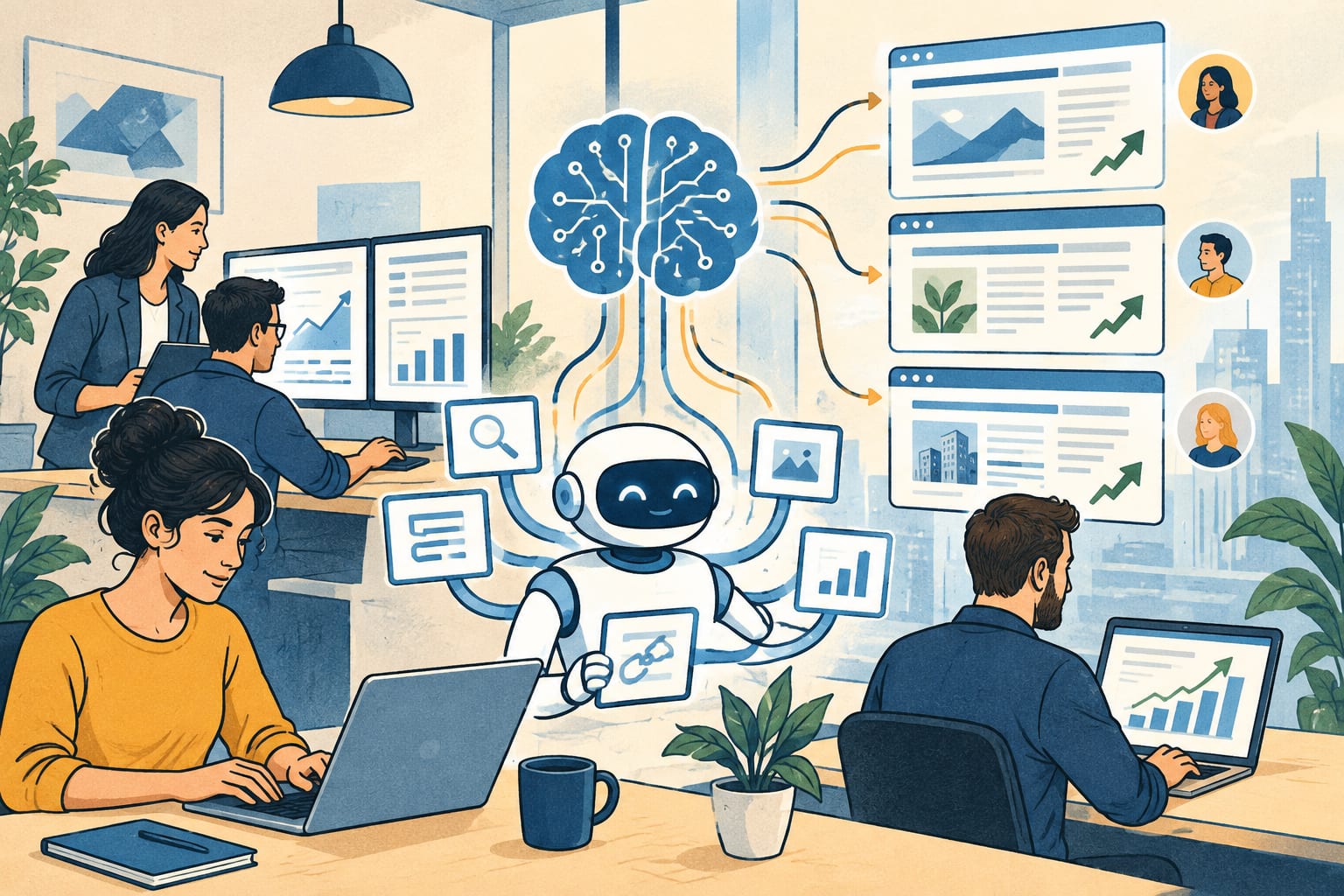
Automation is filling that gap across five areas: keyword research and topical mapping, AI content production, direct CMS publishing, automated indexing, and AI visibility tracking. Platforms now ingest a client's domain, run competitive gap analysis, and generate prioritized keyword clusters within minutes rather than hours. Agencies using AI writers trained on brand voice and top-performing pages report publishing four to six pieces per client per week, compared to one or two on a traditional schedule. Direct publishing to WordPress, Shopify or Webflow with metadata and schema attached removes a persistent friction point, and automated submission to Google Search Console and Bing Webmaster Tools speeds up indexing.
AI visibility tracking is described as the newest and most consequential capability. AI Overviews now appear in roughly 13% of US desktop searches, and agencies that can report a client's citation rate across AI platforms, not just SERP rank, are offering a different value proposition than those tracking position changes alone.
Reporting is also being reshaped. Automated dashboards pull live data from Search Console, rank tracking and content performance, with some platforms allowing full white-labeling so clients see reports under the agency's own brand. That shifts account managers from compiling data to interpreting it. Onboarding timelines are compressing too: traditional setup of two to four weeks is being reduced to days, with platforms scanning a new domain and generating a technical audit and 30-day content calendar automatically.
Impact
The consolidation trend is moving agencies away from fragmented stacks built on tools like Ahrefs or SEMrush plus separate project management, documentation and CMS tools, toward single-login platforms covering research, content, publishing, indexing and reporting. The tradeoff is reduced depth compared to specialized tools, such as backlink databases or dedicated PPC features, but the report characterizes this as an acceptable cost given the efficiency gained. On the strategy side, automation is reframed as shifting work rather than eliminating it: strategists are spending less time on production and more on domain-specific content decisions, link acquisition relationship building, and interpreting performance data for pivots. Agencies treating automation as a replacement for strategy are producing generic content that ranks briefly then declines, while those using it as a multiplier are reportedly growing client base and profitability together.
What to watch
Agencies evaluating automation are advised to start with reporting, since it carries the fastest visible return and least workflow disruption. Content automation is recommended first on lower-stakes or smaller-retainer clients to build internal confidence before rolling out to flagship accounts, and brand voice documentation should be built before automating content to avoid generic output. Investment in AI visibility tracking now, rather than later, is flagged as a way to build baseline data before clients start asking about citation performance. As a senior editor at a trade publication covering this space for working professionals, it's worth noting that tool stack consolidation decisions should be evaluated on operational overhead at scale, not simply which individual tool performs best.
Many agencies now use an auto backlink tool to prospect for link opportunities and send outreach at a scale that manual teams could not match.
Many agencies now pair their AI-driven workflows with an seo backlinks builder to automate outreach and speed up link acquisition for clients.
AI-powered outreach tools now help agencies identify prospects, personalize pitches, and get backlinks faster than manual campaigns allowed.
Source: TechBullion
Earlier in this series: EZ Rankings Releases 2027 Marketing Budget Framework As AI Overviews Reduce Organic Clicks