AI Citation Overlap With Google Rankings Drops to 37.9%, Ahrefs Data Shows
Top-10 Google rankings are no longer a reliable predictor of whether a page gets cited in AI-generated answers, according to new Ahrefs research that shows the overlap between organic rank and AI citation has collapsed over the past year. The finding affects publishers and SEO teams across every vertical that competes for visibility in Google AI Overviews, Perplexity and ChatGPT.
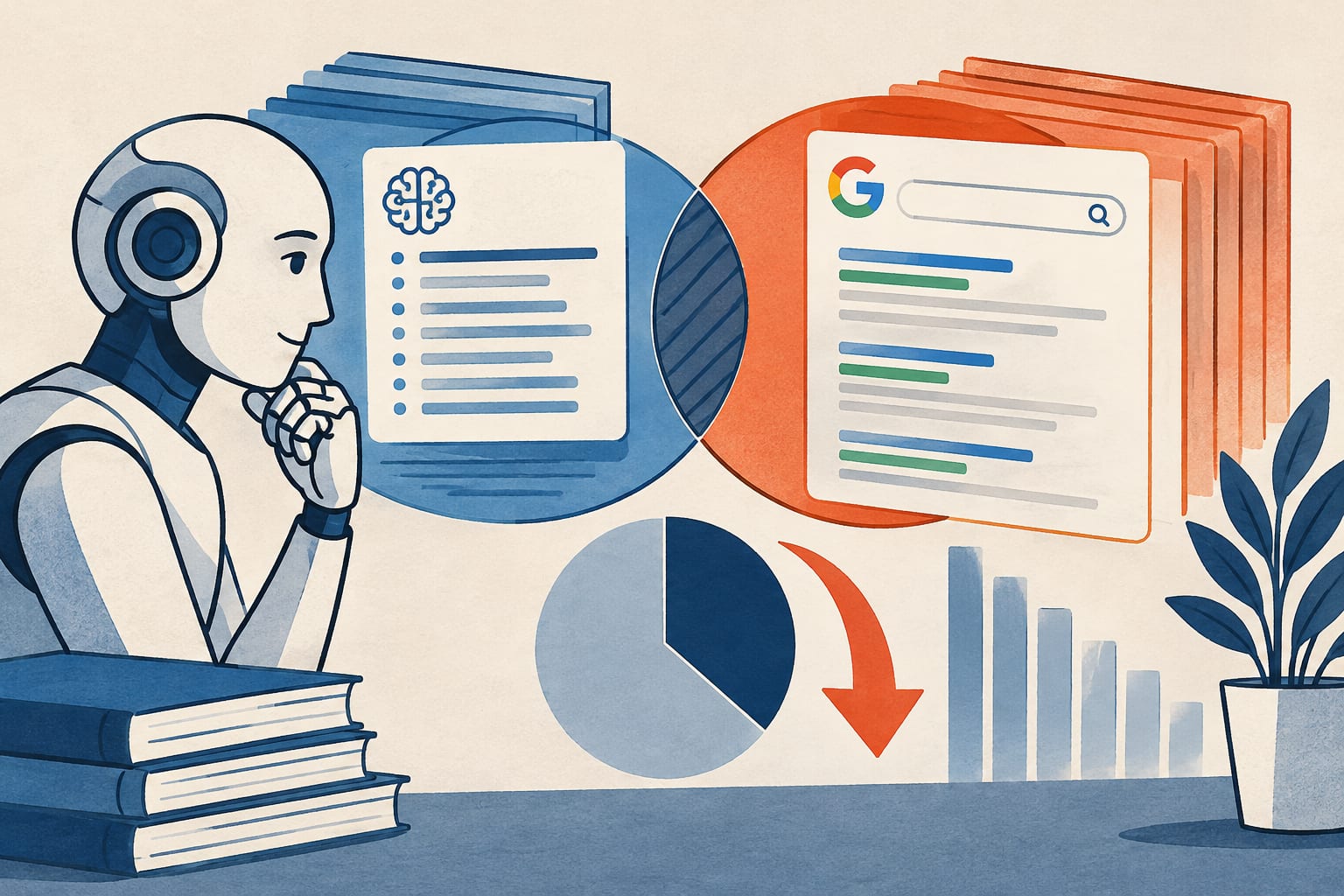
Ahrefs analyzed 863,000 keywords and 4 million AI Overview citation URLs in March 2026 and found that only 37.9% of cited URLs also appeared in Google's first 10 organic results. In July 2025, that overlap stood near 76%. Ahrefs notes it also refined its parsing methodology between the two studies, so the full size of the drop should not be attributed to a single cause. A top-10 ranking still carries weight, but it guarantees far less than it did a year ago.
The research points to query fan-out as a key driver of the divergence. Google breaks a single search into multiple related sub-questions and pulls citations from whichever pages answer those sub-questions most precisely. A page that sits outside the top 10 for its primary keyword can still earn a citation by nailing one fan-out question. Google's own developer documentation confirms that AI Overviews and AI Mode build on existing ranking systems, that no special markup is required, and that artificially shortened content offers no benefit. Standard SEO practice still applies.
A separate Ahrefs study of 15,000 prompts across ChatGPT, Gemini and Copilot found their citations overlapped with Google's top 10 only 12% of the time on average, a figure describing the group rather than any one assistant. Perplexity, measured independently, aligned with Google's top 10 about 29% of the time, the closest match of any assistant tested, because it runs its own retrieval and ranking pipeline rather than drawing directly from Google or Bing. ChatGPT's source selection pulls from a search partner, its own retrieval layer and licensing arrangements with specific publishers, a mix that shapes which pages are eligible but does not explain why one wins a citation over another on a given query.
Impact
The data signals a structural shift for how publishers measure search performance. Citation frequency and referral traffic now measure distinct outcomes, since AI-generated answers can satisfy a query without sending a visit to the source page. Treating the two as interchangeable metrics risks misreading actual performance. Competitively, the gap also means publishers optimizing solely for Google's top 10 may be ceding AI citations to pages that better cover fan-out sub-questions, even when those pages rank lower or not at all for the primary keyword. No format shortcuts, such as chopping content into fragments, show any confirmed benefit for AI systems.
What to watch
Publishers should track which queries and subtopics around their core subjects are already sending citations to competing pages, then identify and fill the specific evidence or explanation gaps on their own content rather than issuing a blanket rewrite. Original data, documented methodology and clearly sourced explanations give retrieval systems something concrete to extract and credit, an advantage plain summary content lacks. Content covering fast-moving subjects needs dated, current facts, since stale figures are an easy disqualifier in retrieval-based citation. Each platform, Google AI Overviews, Perplexity and ChatGPT, should be treated as a separate system with its own selection logic rather than a single shared target, since a strategy tuned for one will not necessarily move the needle on another. As always for working SEO and editorial teams, the practical test is whether a page stands on its own as evidence, not whether it checks a formatting box.
Marketers hoping to influence AI citations should be wary of any auto backlink tool that promises quick gains, since link quality matters more than volume.
Teams tracking how AI search tools cite sources alongside their traditional rankings often pair that analysis with an seo backlinks builder to strengthen the domain authority that still shapes Google visibility.
Sites that rank well in traditional search still need to get backlinks and strong topical authority to earn visibility in AI-generated answers.
Source: Analytics Insight
Missed the last one? Starks Command Launches All-in-One Platform for Local SEO and AI Search Visibility