
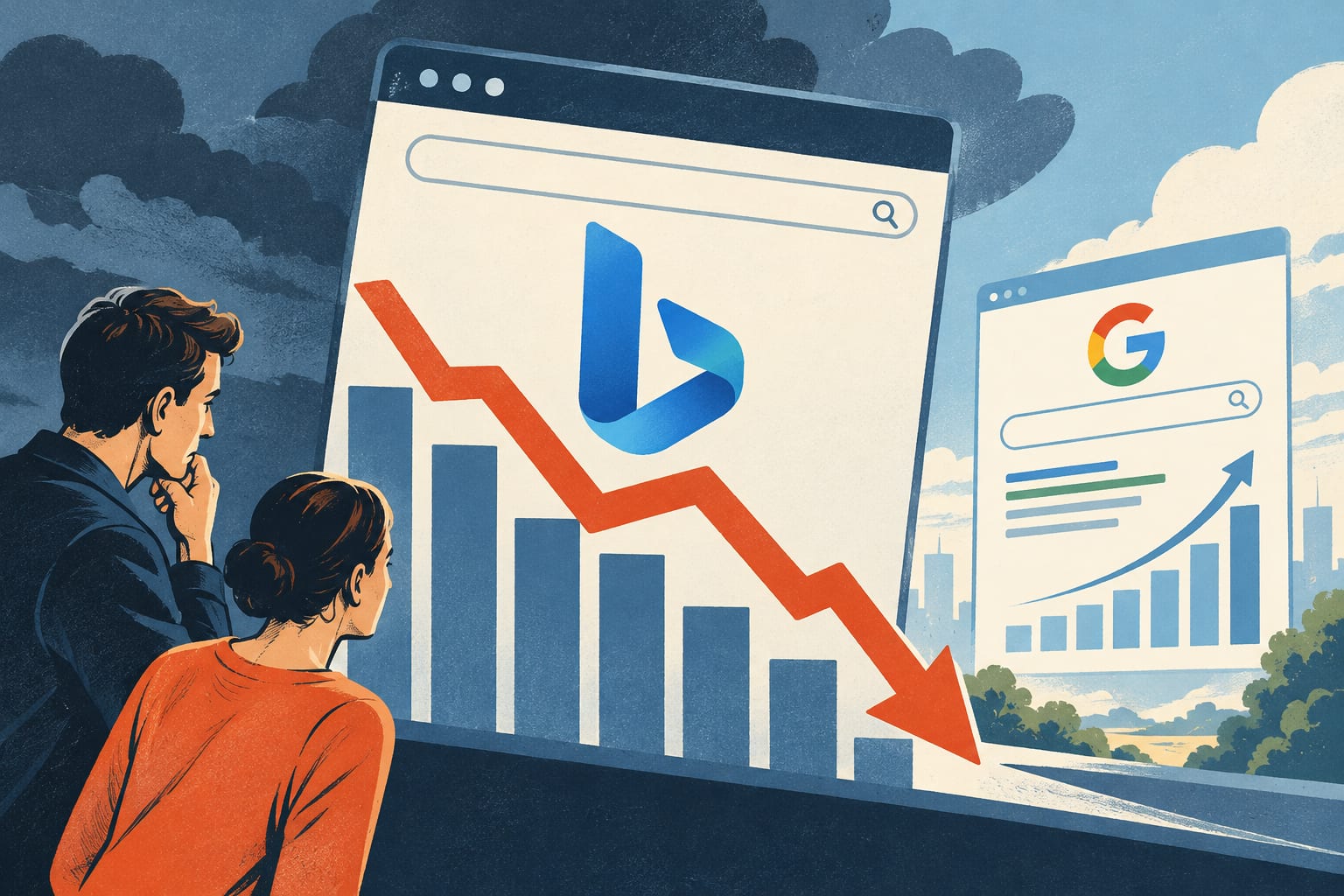
Bing’s Web Traffic Falls 45.6% in a Year, OneLittleWeb Data Shows
Bing lost an estimated 20.13 billion browser visits over the twelve months to September 2026, a 45.64% decline that OneLittleWeb's ranking of the world's most visited websites marks as the steepest drop of any site it tracks. The figures come from OneLittleWeb, an SEO and digital PR agency with offices in Queens, New York and Dhaka, Bangladesh, which built its estimates from third-party analytics providers Semrush, Ahrefs and Aitools.xyz rather than from server logs. The dashboard covers 7,202 websites and shows total tracked visits falling 1.06% year over year to 3.89 trillion, with Google alone drawing 1.21 trillion.
Bing's fall pushed it to 15th place with 23.97 billion visits, below Yahoo! at 28.28 billion and barely ahead of DuckDuckGo at 23.73 billion. Combined, Bing and Yahoo! shed 28.15 billion visits, more than the 18.68 billion ChatGPT gained over the same window. That gain lifted ChatGPT to fifth overall with 70.78 billion visits, ahead of Reddit, Wikipedia and X. Gemini and Claude grew far faster in percentage terms, up 433% and 527% respectively, though from much smaller bases of roughly 2.2 billion and 1.4 billion visits each.
Despite that growth, OneLittleWeb's traffic-source breakdown shows AI services, including the AI Traffic channel and Google's AI Mode, sent just 7.46 billion visits to tracked sites, about 0.2% of the total. Search engines sent 481.30 billion, more than 60 times as much. Direct and search traffic together accounted for 92.1% of all visits.
The picture conflicts with other measurements. Microsoft reported search advertising revenue excluding traffic acquisition costs up 10% in the quarter to June 30, 2026, and chief executive Satya Nadella said Bing and Edge have gained audience share in search and advertising for five straight years. Datos found Bing's US desktop search share falling from a December 2025 peak of 5.33% to between 3.2% and 3.8%, a drop measured over three months rather than a year. Cloudflare's 2025 Year in Review put Bing at 3.1% of search engine referrals. None of these measure the same thing as OneLittleWeb's estimated browser visits to a single domain, and OneLittleWeb does not explain Bing's decline.
Impact
OneLittleWeb's own numbers carry inconsistencies that limit how far marketers should lean on them. The page cites coverage of "29+ industries" and "163+ countries" while its country table lists 222. Country-level shares appear to rest on a different total than the rest of the page: the United States' reported 911.78 billion visits and 25.13% share imply a base near 3.63 trillion, not the 3.89 trillion used elsewhere. The dashboard itself has also changed shape. A version covering the twelve months to April 2026 tracked 10,173 domains and 3.44 trillion visits; the current version tracks 2,971 fewer sites yet records 13% more visits, with no explanation of which domains were dropped or whether earlier estimates were revised.
Other sectors show losses that echo Bing's. Wikipedia fell 14.81% to 51.12 billion visits, its traffic historically reliant on Google organic search. News and Media dropped 14.47%, consistent with Chartbeat findings that small publishers have lost 60% of search referrals over two years. Amazon's web visits fell 15.79%, though the figures exclude app activity entirely, a gap that also affects Google Play's 38% web decline. The AI Tool industry, by contrast, grew 32.14% to 159.57 billion visits, with ChatGPT, Gemini and Claude accounting for roughly 91% of that growth.
What to watch
PPC.land's senior editor, writing for professionals who track these metrics daily, notes that the gap between OneLittleWeb's browser-visit estimates and Microsoft's own share claims deserves close attention before anyone treats Bing's decline as settled fact. Search marketers should watch whether Datos, SparkToro, Cloudflare or Similarweb publish comparable full-year figures that either confirm or contradict the 45.64% drop. The AI referral question also needs monitoring: Google's noreferrer attribute bug previously caused AI Mode visits to register as direct or unknown traffic, and Google Analytics only introduced a dedicated AI Assistant channel in May 2026, meaning current AI-attribution totals may understate real influence. Anyone citing OneLittleWeb's rankings should flag the unexplained shift in tracked domain count and the mismatched country-level totals before drawing conclusions about market share.
Website owners tracking shifts in search engine referrals sometimes use an auto backlink tool to monitor how changing traffic sources affect their link-building efforts.
Site owners worried about shrinking search referrals often combine content quality with a reliable seo backlinks builder to strengthen authority and diversify traffic sources.
Publishers who want to stay visible as search referrals decline may need to work harder to get backlinks from sources that still drive steady traffic.
Source: PPC Land
Missed the last one? WowLink Launches as Backlink Marketplace With Bundled Free Checker Tool